ClickFunnels Review: pricing, features and honest opinion 2026

ClickFunnels is a platform built to create landing pages and sales funnels without assembling a complex technical stack from scratch. It is used to capture leads, sell products, or book sales calls by moving users through a sequence of pages designed to convert. In this guide, we explain what ClickFunnels is, how it actually works, its 2026 pricing, and whether it is worth it depending on your business model.
- What ClickFunnels is
- How ClickFunnels works
- Key features of ClickFunnels
- ClickFunnels pricing 2026
- Pros and cons of ClickFunnels
- Alternatives to ClickFunnels
- Who ClickFunnels is for and who it is NOT for
- TeideSEO final opinion and rating
- Frequently asked questions
- Conclusion
What ClickFunnels is
If someone asks what ClickFunnels is, the short answer is this: it is a platform designed to build lead generation and sales funnels without relying on custom development. Its purpose is not to create a traditional corporate website, but to organize pages, forms, checkouts, and automations into a conversion-focused sequence. That conversion might be a purchase, a booked call, a webinar registration, or a lead magnet download. That is why it belongs in the landing pages and funnels category rather than the CMS or general website builder category.
At TeideSEO, we see ClickFunnels solving a very specific problem: many businesses have traffic, ads, or a solid offer, but they do not have a clear conversion path. They send users to a generic page, distract them with menus and mixed messages, and end up losing opportunities. ClickFunnels tries to simplify that process through pre-built funnel structures, direct-response templates, and a workflow built around getting users to take the next step. That specialization is its main strength, even though it also creates limitations compared with more open systems.
Who is it for? Mostly businesses that sell through a sequential process: consultants, course creators, coaches, sales teams, agencies building funnels for clients, ecommerce brands running specific offers, and service companies generating qualified leads. It can also work for smaller businesses that want to launch a campaign quickly without building an entire website first. Where it makes less sense is in projects where SEO is a core growth channel, the site structure needs to be complex, or the design must be highly customized. In those cases, a more controlled setup usually performs better, like the kind of builds we develop through our premium web design service.
How ClickFunnels works
ClickFunnels works as a visual builder connected to a commercial logic layer. The user creates a funnel by selecting a template or starting from scratch, defines the steps in the journey, and edits each page with visual blocks. Each step in the funnel is linked to the next one: lead capture page, sales page, form, checkout, upsell, downsell, thank-you page, or booking page. In practical terms, the platform stores the funnel structure, conversion events, and captured form data so that information can be used inside the platform or pushed to third-party tools. That is the actual foundation of the system: linked pages, forms, automation, and journey tracking.
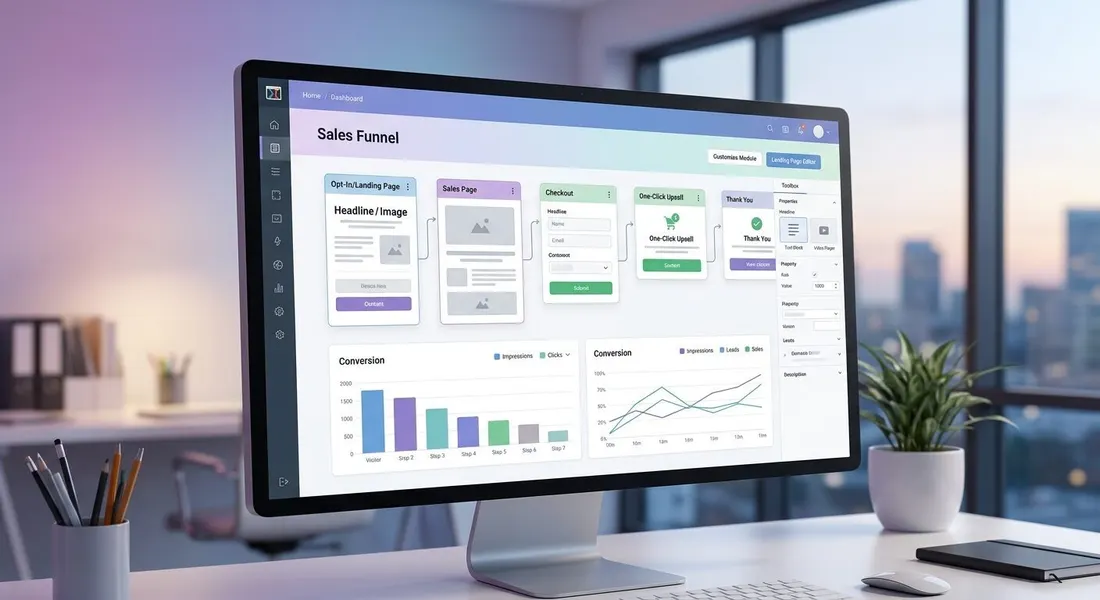
The real user workflow usually looks like this. First, you define an offer and an objective: capture leads, sell a low-ticket product, book calls, or run a webinar. Then you choose a funnel type and customize pages, copy, buttons, forms, and checkouts. After that, you connect the domain, payment gateway, email tool, and, if needed, a CRM or other apps via native integrations or webhooks. Once the funnel is live, ClickFunnels tracks visits, leads, sales, and conversion rates by step. It does not fully replace advanced analytics like GA4 or a serious CRM in complex operations, but it gives enough visibility to understand whether the funnel converts and where users drop off.
From a technical standpoint, this is not an open CMS where you control the server, database, and codebase in depth. ClickFunnels is hosted software, so infrastructure, updates, and maintenance are managed by the vendor. That makes deployment easier because you do not have to deal with hosting or plugin conflicts, but it also reduces flexibility. The editor is based on predefined visual components, with some room for CSS or scripts depending on plan and setup, though it is not the ideal environment for highly customized development. Operationally, that means you gain speed and lose part of your technical control.
Another important aspect is how user data is handled. When someone fills out a form or completes a purchase, the platform captures that data, associates it with the funnel, and can trigger follow-up actions such as tagging the lead, enrolling them into a sequence, sending notifications, or routing them to another page based on the logic you set. If your project needs strict compliance, advanced segmentation, or unified reporting across multiple channels, you need to carefully review how ClickFunnels fits into your stack and which data stays inside the platform versus what gets synced elsewhere. In serious projects, we do not leave the entire strategy in the hands of the funnel builder alone; we integrate it into a broader acquisition architecture, especially when the brand also needs organic visibility and a stronger web foundation.
The daily experience for non-technical users is relatively simple at first: choose a funnel, edit blocks, connect forms, and publish. The difficulty appears when you want to coordinate multiple layers at once, such as campaign attribution, complex automations, meaningful A/B testing, source tracking, and a consistent brand experience between your funnel and your main site. That is where ClickFunnels stops being just drag-and-drop and starts requiring judgment. That is why we always say it is not enough to know how to use the software; you need to know how to design the sales process. A weak funnel built in ClickFunnels is still a weak funnel.
Key features of ClickFunnels
Visual funnel and page builder
The core function of ClickFunnels is its visual builder for landing pages, sales pages, forms, checkouts, and thank-you pages within a single flow. What matters is not only dragging blocks around but seeing the full funnel sequence and editing each step without leaving the platform. That speeds up execution significantly when you need to launch campaigns fast. For a business selling coaching packages, for example, you can build a lead page, a booking page, and a thank-you page with instructions in one focused work session.
That said, the editor does not offer the same level of control as a custom build or a more open website builder on WordPress. Some layout, spacing, structure, and behavior decisions are shaped by the platform itself. It works well for direct-response sales pages, but when a brand needs richer editorial structure or tighter design precision, those limits become noticeable. We often see businesses start with ClickFunnels and later migrate to a stronger website setup that better supports branding, SEO, and long-term user experience.
Templates focused on lead generation and sales
ClickFunnels includes templates designed for specific goals: lead generation, webinars, tripwires, digital product sales, call bookings, and presentation pages. This saves time for users who do not want to start from a blank page, because the core structure with headlines, sections, and calls to action is already there. For campaigns with short deadlines, these templates help teams publish faster and avoid basic funnel architecture mistakes. For small teams, that advantage is very real.
The downside is that many templates feel similar and are heavily influenced by the U.S. direct-response style. If used without adaptation, the result can look generic or too aggressive for certain industries and audiences. In many European and premium service markets, that style can reduce trust instead of improving it. That is why we see templates as starting points, not finished solutions. If the project needs to communicate premium positioning, the funnel should be paired with a more polished website presence and a coherent visual identity, something we often address through our premium web design service.
Checkouts, order bumps, and upsells
One of the most attractive ClickFunnels capabilities for direct selling is the ability to build checkouts aimed at increasing average order value. You can add order bumps, upsells, and downsells without building a full ecommerce store or relying on complex custom development. This works especially well for online courses, memberships, ebooks, events, and packaged services. If your business depends on improving the value of each customer acquired, this layer can make a meaningful difference.
In real use, however, simply turning those features on is not enough. You need to define the main offer, the add-on, the right timing, and how much friction you introduce. We have seen funnels overloaded with upsells that damage the buying experience. We have also seen simple, relevant order bumps improve revenue per transaction without making the funnel feel pushy. ClickFunnels makes those mechanics accessible, but profitability still depends on offer design and understanding user behavior.
Basic automation and lead follow-up
ClickFunnels lets you capture data, segment contacts, and trigger basic actions after a signup or purchase. That can include emails, list assignments, sequence enrollment, or connections with third-party tools. For small businesses or campaign-based use cases, this level of automation is often enough to keep leads from going cold and to build a simple follow-up process. If someone downloads a guide, for example, you can route them to a relevant offer, email them, and track whether they return to buy.
We would not rank it alongside specialized CRMs or advanced marketing automation tools in long sales cycles or complex team environments. ClickFunnels handles the essentials, but it falls short in scenarios requiring advanced lead scoring, multichannel reporting, sophisticated pipelines, or delicate sync logic. In those cases, it works better as the acquisition layer than as the central operating system. That distinction matters because many users buy ClickFunnels expecting it to replace several tools at once and later discover that forcing it into that role does not always pay off.
Step-by-step funnel analytics
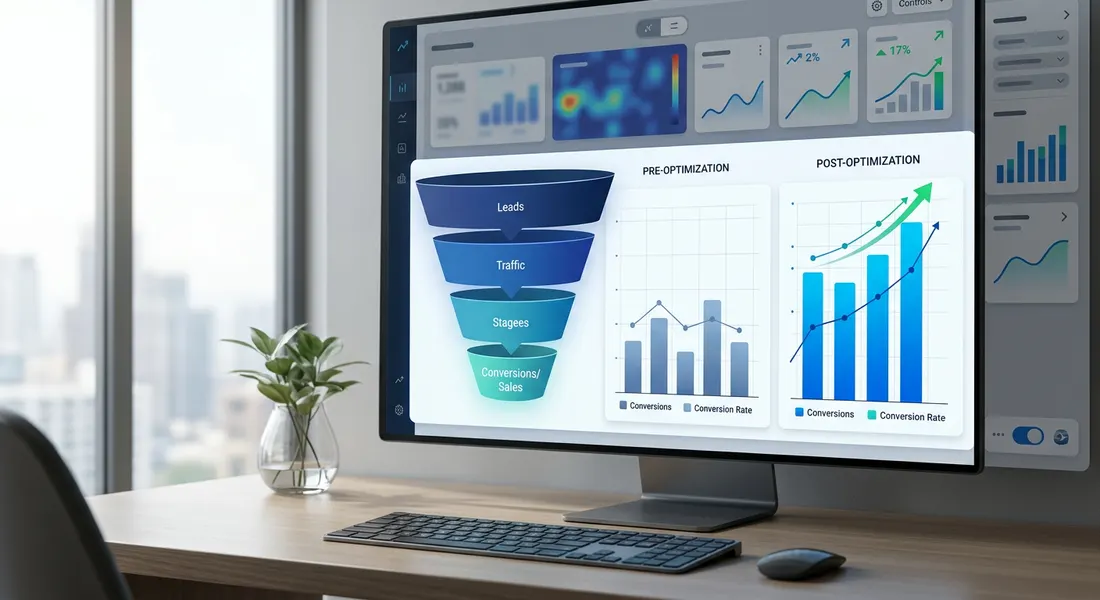
Another valuable feature is funnel-step reporting: visits, conversions, sales, and page-level performance. This helps identify bottlenecks without setting up a technical dashboard from scratch. If a landing page gets clicks but the form does not convert, or if checkout abandonment is too high, the issue becomes visible quickly. For teams running paid traffic and needing fast decisions, that operational visibility is useful.
Still, native analytics do not replace a proper measurement setup. We continue to recommend tracking events in GA4, validating data against ad platforms, and comparing performance with CRM or revenue data. Funnel attribution can be misleading if you ignore the full customer journey. ClickFunnels gives you a good tactical view for optimization, but not the full truth of the business. Users who understand that will get more value from it.
Integrations with payments, email, and external tools
ClickFunnels supports integrations with payment gateways, email marketing tools, and a range of other apps. This matters because an isolated funnel is not very useful if it cannot collect payments, nurture leads, or send data into the rest of your commercial stack. In simple businesses, connecting Stripe, an email provider, and a scheduling tool can be enough to get the entire process running. That speed is one of the reasons the platform still matters.
The less convenient side is that not all integrations are equally smooth or equally deep. Some require middleware, manual adjustments, or external connectors. As a business grows, it becomes increasingly important to review how data flows between systems and what breaks when one piece changes. This is not unique to ClickFunnels, but it is worth saying clearly: the more sophisticated your sales stack becomes, the more you need architecture thinking rather than just app connections.
ClickFunnels pricing 2026
ClickFunnels pricing has always been one of the most debated parts of the product. It is not a cheap choice for someone who only needs a single landing page, and that needs to be said directly. It makes sense when you are genuinely using the funnel logic, the checkout layer, and several connected pieces of the system. Otherwise, the monthly cost starts to feel expensive very quickly.
ClickFunnels has also changed parts of its pricing structure over time, so the honest way to present it is as a current market reference rather than an eternal fixed truth. For this review, we use the plan structure most commonly available to standard users in 2026. Temporary promotions or trials may affect initial access, but not the core reality: this is a premium tool aimed at businesses expecting direct return from funnels.

| Plan | Price/month | Includes | Best for |
|---|---|---|---|
| Free trial | $0 for a limited period | Temporary access to the platform, basic funnel creation and testing with restrictions depending on the current offer | Users who want to validate the interface and workflow before paying |
| Basic / Startup | $97/month | Funnels, pages, forms, checkouts, basic analytics, and essential integrations | Entrepreneurs, coaches, small businesses, and specific lead generation campaigns |
| Pro | $297/month | More funnel capacity, more users or workspaces, broader automation, and stronger scaling options | Marketing teams, agencies, and businesses running multiple offers |
Prices verified in May 2026. They may change.
The free trial, when available, is useful to confirm whether the platform fits your workflow, but we would not describe it as a true permanent free version of ClickFunnels. It is good for testing the editor, reviewing templates, and even building something basic, though the real value shows up once you connect payments, traffic, and follow-up systems. If your plan depends on using ClickFunnels for free indefinitely, it is not the right platform. If you just want to lower the risk before subscribing, the trial does its job.
The basic plan at around $97 per month is the most sensible entry point for a small business centralizing one clear offer. It lets you launch funnels and operate without too much overhead, as long as your volume and complexity remain moderate. We find it reasonable for info products, lead generation, or packaged services where one sale can easily justify the subscription. In low-ticket businesses or thin-margin environments, the cost-benefit equation becomes harder to defend.
The Pro plan at roughly $297 per month only makes sense when you need scale or multiple active funnels running at once. The key is not just capacity but also better organization for teams, assets, and commercial operations. For an agency or a company running several offers, it can make sense. For a freelancer still validating the offer, usually not. Before upgrading, we recommend confirming that the actual bottleneck is platform capacity rather than your offer, traffic, or conversion fundamentals.
Pros and cons of ClickFunnels
Pros
- It dramatically speeds up funnel launches. If you already know what you want to sell, you can move from idea to published funnel very fast. That matters in deadline-driven campaigns, launches, or market tests where speed is more important than technical perfection. For businesses needing fast validation, this advantage is significant.
- It combines pages, checkout, and core selling logic in one place. You do not need to stitch together multiple tools from scratch to handle capture, sales, and basic follow-up. That simplifies operations and reduces the usual mess of disconnected forms, pages, and plugins. For small teams, that convenience is a genuine benefit.
- It is highly focused on direct response conversion. ClickFunnels is not trying to be everything for every kind of website. It is designed to move users step by step toward a conversion. That specialization shows up in features like order bumps, upsells, and sales flows. If your business sells through funnels, this focus is useful.
- The learning curve is manageable for non-technical users. A marketer can build a working funnel without depending too heavily on a developer. That creates autonomy and shortens turnaround time when changes are needed. In fast-moving teams, that independence matters.
- It gives useful step-level performance visibility. Even though its analytics are not a complete business intelligence layer, they are enough to spot weak points inside a funnel. Seeing where users drop off helps prioritize improvements. For fast campaign optimization, that is valuable.
Cons
- It is not the best choice for SEO or a strong corporate website. ClickFunnels is built for funnels, not for a rich, scalable content architecture that supports long-term organic growth. If SEO is important to your business, it usually falls short. In those cases, we prefer a stronger core site setup with more control.
- The design can feel generic unless you work on it heavily. Many ClickFunnels pages share the same visual rhythm, structure, and sales style. That can work in some niches, but in premium brands or trust-sensitive sectors it can hurt credibility. Using a template and changing colors is rarely enough.
- The monthly cost becomes hard to justify if you do not fully use the funnel. For anyone who only needs a landing page or has not yet validated the offer, the subscription can become a painful fixed expense. We have seen businesses pay for months before having the traffic or positioning to make it worthwhile. In those cases, the issue is timing as much as the tool itself.
- It is a more closed environment than a custom stack. You gain speed, but you give up flexibility and part of your control over structure, performance, and customization. As the project matures, that dependence can become a limitation or make future migration more expensive. It is better to accept that from day one than pretend it offers the same freedom as a custom build.
Alternatives to ClickFunnels
Looking at ClickFunnels alternatives makes sense because not every business needs the same level of commercial complexity. Some only need a simple landing page, others need full sales funnels, and others prioritize design, SEO, or lower cost. The right choice depends on how you sell and which part of the process you want to centralize. We compare alternatives based on real-world fit, not inflated feature lists.
| Tool | Starting price | Best for | Our rating |
|---|---|---|---|
| Leadpages | $49/month approx. | Simple landing pages and fast lead capture | 8.0/10 |
| Kartra | $99/month approx. | Funnels combined with email and more integrated operations | 7.8/10 |
| Unbounce | $99/month approx. | Landing page optimization and testing | 8.2/10 |
| GoHighLevel | $97/month approx. | Agencies and CRM-driven automation | 8.1/10 |
| WordPress + custom stack | Variable | SEO, brand building, and long-term technical control | 8.7/10 |
Leadpages is usually the clearest alternative when you do not need such an aggressive sales funnel structure and simply want pages that convert. It is lighter, simpler, and usually easier to justify on cost. We recommend it for businesses capturing leads and closing later through email or calls. If you are not going to use order bumps, upsells, and built-in sales mechanics, it is often a smarter choice than ClickFunnels.
Kartra competes around the idea of combining multiple parts of the digital business into one system. It makes sense for users who want pages, email, automation, and business operations in a more unified environment. The tradeoff is that it can feel less direct and the learning curve is not especially gentle. If you want an all-in-one marketing system and are willing to invest the time, it is a serious option.
Unbounce is especially strong when the main objective is high-performing landing pages, rapid testing, and tighter control over conversions without turning the whole setup into a traditional funnel architecture. We like it for paid media teams that need to experiment quickly with variants. It does not replace ClickFunnels if your model depends on upsells and funnel sequencing, but it outperforms many tools for pure landing page use cases.
GoHighLevel has grown quickly, especially among agencies and businesses wanting CRM, automation, lead management, and funnels in one place. Compared with ClickFunnels, it offers a broader operational layer for sales follow-up and more advanced automation. It is not always easier to use, and much depends on how well it is implemented. For agencies handling multiple clients, it can deliver better value than ClickFunnels if they truly use the full ecosystem.
WordPress with a custom stack is not a packaged alternative in the same way as the others, but in many projects it is the better decision. If the brand needs organic authority, content depth, site performance, visual control, and real scalability, we usually prefer building a stronger foundation and then connecting only the conversion tools that are actually needed. It requires more strategy and usually more work upfront, but it gives much more freedom. For businesses that want SEO and conversion working together, this route is often more intelligent than relying entirely on ClickFunnels.
Who ClickFunnels is for and who it is NOT for
ClickFunnels is not a universal tool. It performs well when the business fits its selling logic, but we do not recommend forcing it into projects where the real problem lies elsewhere. Choosing it because it is popular often ends in an expensive subscription and a weak implementation. Choosing it because your process genuinely needs a sequential funnel is a very different story.
Who it is for
- Businesses selling courses, memberships, coaching, or packaged services through a clear and measurable offer.
- Teams running paid campaigns that need to launch funnels quickly without ongoing development dependency.
- Consultants, coaches, and service companies generating leads to close through calls or automated sequences.
- Brands looking to improve average order value through upsells, order bumps, and structured sales flows.
Who it is NOT for
- Companies whose growth depends on SEO, content depth, and a rich, scalable website architecture.
- Premium brands that need highly customized design and a less templated customer experience.
- Businesses that have not yet validated their offer, messaging, or acquisition channel and expect the tool to fix that.
- Projects with complex operations, advanced CRM needs, or technical requirements where a closed system becomes restrictive.
TeideSEO final opinion and rating
At TeideSEO, we have analyzed ClickFunnels for both client projects and internal use. Our view is fairly straightforward: it works well when it is used for what it was built to do, which is launching and optimizing conversion-focused sales funnels. If a business already has a validated offer, understands its sales process, and needs speed to publish campaigns, ClickFunnels can save time and reduce technical friction. In those scenarios, we do recommend it, especially for info products, lead generation, and service businesses closing through calls or direct checkout.
Where we do not recommend it is in projects that confuse a funnel with a website. A brand that needs organic visibility, a strong content architecture, refined technical performance, and a truly distinctive design should not rely on ClickFunnels as its primary digital base. We also see problems when it is purchased too early, before there is enough traffic, message clarity, or offer validation. In those situations, the platform does not multiply results; it simply makes the lack of strategy more obvious.
Our score: 7.4/10 — it stands out for implementation speed and strong sales focus, but loses points for cost, limited flexibility, and weaker fit for SEO- and brand-led growth strategies.
If the goal is to sell through funnels and move fast, it can be a useful choice. If the goal is to build a stronger and more scalable digital asset, we prefer a strategic website foundation and then layering conversion systems where they add value. That approach usually performs better over the medium term for many businesses that come to us wanting something more durable than a standalone funnel.
Frequently asked questions
Is ClickFunnels worth it?
ClickFunnels is worth it if your commercial model depends on structured funnels and fast conversion. We are talking about businesses with clear offers, paid traffic, course sales, packaged services, or lead generation flows that end in calls. In those cases, the platform removes a lot of friction from launching and testing conversion paths. If your priority is SEO, technical flexibility, or a stronger website foundation, we do not see it as the best investment.
You also need to evaluate expected return before subscribing. If a single sale covers several months of the software cost, the subscription makes sense. If you still do not have traffic or a refined offer, paying for ClickFunnels too early is usually a mistake. The platform does not replace strategy, copywriting, or product-market fit.
Does ClickFunnels have a free version?
ClickFunnels is not typically a freemium product with a permanent free tier. What you usually get is a limited free trial that depends on the current offer. That trial lets you explore the interface, build an initial funnel, and understand the workflow. For serious ongoing use, though, you need a paid plan.
If you are looking for a permanently free funnel solution, you should probably consider lighter landing page tools or more budget-oriented builders. The trial reduces risk, but it is not the same as a long-term free plan. Always review the active terms, limits, and duration because those details can change.
How much does ClickFunnels cost?
In 2026, ClickFunnels pricing generally starts around $97 per month for the basic plan and goes up to roughly $297 per month for the Pro plan, based on the most common structure available to standard users. Promotions and trials may shift the entry point, so it is always wise to verify the final amount before subscribing. The entry plan is usually enough for small or mid-sized businesses with one main funnel. The higher plan is more relevant when several funnels, more users, or a heavier commercial operation are involved.
The key question is not only how much it costs but whether the return justifies that cost. For a high-ticket business, the monthly fee may be perfectly reasonable. For an early-stage business or one with slim margins, it may be too expensive. That is why the answer depends heavily on your sales economics.
Is ClickFunnels available in Spanish?
ClickFunnels can be used by Spanish-speaking teams, but it does not always provide a fully localized experience across every menu, resource, and training area. A lot of the ecosystem still feels strongly oriented toward the English-speaking market. If you or your team are reasonably comfortable with English, that may not be a big issue. If not, the onboarding and learning process can become slower and less comfortable.
This matters most in support materials and education. You can absolutely build funnels targeting Spanish-speaking audiences, but the product experience itself is not always fully adapted. For teams that require complete localization, this is a meaningful factor to consider before committing internal processes to the platform.
ClickFunnels vs Leadpages: which one is better?
Between ClickFunnels and Leadpages, the better tool depends on how deep your sales system needs to go. ClickFunnels wins when you want a multi-step funnel with checkouts, upsells, and structured sales logic. Leadpages wins when you mainly want effective landing pages to capture leads or validate campaigns without building a more advanced funnel. It is also usually easier to justify financially.
We recommend ClickFunnels if you sell through a defined sequence and want to centralize much of that process. We recommend Leadpages if your focus is the lead capture page and the rest happens through email, CRM, or sales calls. There is no point paying for ClickFunnels complexity if you are not going to use it. Choosing correctly here saves both time and money.
Can ClickFunnels work for ecommerce?
ClickFunnels can work for selling specific products, bundles, entry offers, or launches where the funnel logic matters more than a traditional store experience. It performs better in focused offer-based ecommerce than in large catalogs with navigation, filtering, and complex product structures. If you sell a limited number of products with a strong sales story, it can work well. If you need a full online store, Shopify or WooCommerce will usually make more sense.
The key is understanding what you are optimizing for. ClickFunnels is strongest when the campaign revolves around one offer and one controlled journey. It is not designed as a complete catalog ecommerce platform. If you try to force it into that role, you will run into avoidable limitations.
Is there an easy ClickFunnels tutorial for beginners?
Yes, but the biggest mistake is assuming the problem is only learning where the buttons are. A ClickFunnels tutorial will teach you how to create pages, connect forms, and publish a basic funnel. That is useful for getting started. The real challenge comes after that: defining the offer, sequencing the journey, writing the copy, handling objections, setting follow-up, and measuring actual conversions.
We recommend starting with one simple funnel and one main conversion goal. Do not try to build a lead magnet, webinar, sales page, upsell chain, and advanced automation system on day one. Learn the basic flow, measure it, and improve from there. The software itself is relatively learnable; designing a funnel that genuinely sells takes much more judgment.
Conclusion
ClickFunnels makes sense when you need to generate leads or sales through a clear funnel and want to get it online without assembling a complex technical stack from scratch. If your business needs a stronger digital foundation with SEO, branding, and real ownership over the asset, it is smarter to build that base first and use funnels only where they add value. If you want that kind of strategic foundation, take a look at our related TeideSEO service.